
At some point, you’ve read something and bought something you weren’t planning to buy.
Maybe it was an email subject line that pulled you in at 11pm or a product page that somehow made you feel like the thing was already yours.
That didn’t happen by accident. It wasn’t the design, the discount, or the algorithm. It was the words. Specifically, it was the way the words were chosen, not to sound impressive or to fill space, but to make you feel something that made the next step feel obvious.
That’s copywriting.
What Is Copywriting?
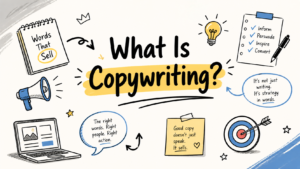
Copywriting is the craft of writing words that move people to act. It appears in ads, emails, landing pages, product descriptions, sales letters, scripts, and anywhere a brand needs to persuade rather than simply inform. Unlike content writing which builds trust over time by educating and attracting, copywriting has a specific job in a specific moment: to get someone to do something. Click. Buy. Sign up. Believe.
Contrary to popular opinion, copywriting is not about clever words. Clever words are often the enemy of good copy. Copywriting is about clear thinking, about understanding what a person wants, what they are afraid of, and what they need to hear before they will move. The understanding comes before the writing.
The difference between copywriting and other kinds of writing is best understood through contrast.
A product description might say: ‘Noise-cancelling headphones with 30-hour battery life and premium audio drivers.’ That is content; accurate, informative, useful.
Copy for the same product might say: ‘Put these on. The world goes quiet.’ One describes a product, the other describes a feeling. One informs, the other moves.
That gap between describing and persuading is where copywriting lives. And learning to close that gap deliberately is what copywriting basics are really about.
How a Copywriter Actually Thinks
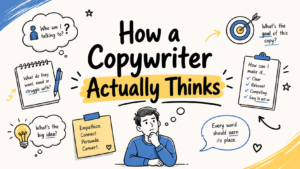
A copywriter doesn’t start with words, they start with a person. Not a demographic, a person. Someone specific, with a specific problem, sitting in a specific moment of their day.
What is this person trying to do? What has already gotten in their way? What are they afraid of getting wrong? What would they need to believe for this product, this offer, this idea to feel like the right choice?
The copywriter’s job is not to create desire. The desire is already there. The reader already wants to feel better, work less, earn more, be seen, solve the problem they’ve been carrying.
The copywriter’s job is to find the words that connect what already exists inside the reader to what’s being offered. That connection and moment of recognition is what converts.
Before writing, a good copywriter asks; “what is the reader’s internal monologue right now?” “What language do they use when they complain about it to a friend?” “What have they already tried?” “What made them distrust the last solution?”
If you can answer those questions specifically, not generally, not based on assumptions, but based on real observation, the words start to come naturally. Because you’re not inventing a message, you’re reflecting one back.
This is why the best copywriters are curious listeners. They read reviews. They notice patterns in the language customers use.
They pay attention to the specific words people reach for when they’re frustrated, hopeful, or uncertain. Then they use those exact words because familiarity creates trust in a way that polished language never can.
The Core Skills of Copywriting
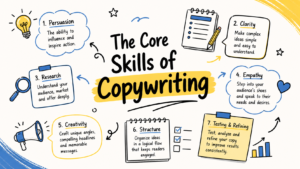
Empathy
Empathy in copywriting is not a soft skill, it is the foundation of everything. Before you can write a word that moves someone, you have to understand their world in terms of what they want, what they’re afraid of, what they’ve already tried, and what they’re quietly hoping for.
The copywriter who skips this step writes copy that sounds right but lands wrong. It might be clear, structured, even technically excellent, but it will miss, because it wasn’t written for the actual person reading it.
Clarity
Clarity is the discipline of saying the most important thing in the fewest possible words. This sounds simple but most times, it is not. Most first drafts of copy are full of hedges, qualifiers, and sentences that are technically accurate but doing no real work.
Clarity requires cutting those sentences without mercy. If a word doesn’t earn its place, it goes. Real clarity is the result of real thinking. When the thinking is clear, the writing gets shorter.
Specificity
Specificity is one of the most reliable tools in copywriting, and one of the most underused. Vague claims; ‘amazing results,’ ‘incredible value,’ ‘proven system’ This slide off the reader’s brain without sticking. Specific claims land. ‘Lost 11 pounds in six weeks.’ ‘Used by 40,000 teams.’ ‘Reduced support tickets by 62% in the first month.’ The specific detail is the proof. It makes the claim feel real, because it is real.
Curiosity
The best copywriters are genuinely curious about people, products, and the gap between the two. Curiosity is what allows a writer to find the interesting thing inside an ordinary product. Every product has one. A feature that solves a problem nobody talks about.
A detail that signals quality in a way the customer will care about. An angle that no competitor has thought to take.
Finding that angle requires asking questions that most people don’t bother with. Not just ‘what does this product do?’ but ‘what does this product let someone stop doing?’ Not ‘what are the features?’ but ‘which of these features would make someone’s Tuesday feel different?’ Curiosity turns copywriting from assembly into discovery.
By the way. these are the best facebook Adcopy examples you will find anywhere.
Types of Copywriting And When Each Applies
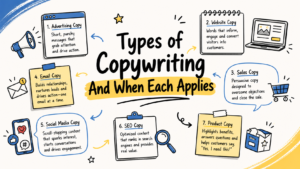
Copywriting covers a wide range of formats and contexts. Understanding the landscape helps both because different situations call for different approaches, and because the discipline underneath each type remains consistent.
Ad copy is the most immediate form of copywriting. It is short, targeted, and built to earn attention in seconds. It appears in paid social, search results, display ads, and anywhere a brand needs to stop a scroll or win a click. The constraint is tight and every word is load-bearing.
Sales copy operates at longer range. Sales letters, long-form landing pages, VSLs (video sales letters). These formats have room to build a case, address objections, and earn trust before asking for a significant commitment. The writing has to sustain momentum over several hundred or several thousand words.
Email copywriting sits in a unique position.
It reaches an audience who has already said yes once (they opted in), but who can leave just as easily (they can unsubscribe). The job is to be worth reading consistently. To make opening the email feel like a small reward, not an obligation.
SEO copywriting blends the demands of search intent with the mechanics of persuasion. It has to satisfy what the reader is looking for and move them in a direction. The search engine is the intermediary, the human is still the target.
Brand copywriting shapes how a company sounds across every touchpoint including tone of voice, taglines, the language used in product names and onboarding flows. It is less about a single conversion and more about a consistent feeling that builds over time.
UX and conversion copywriting focuses on the micro-moments; the button label, the form placeholder text, the error message, the empty state. Each one is a small piece of sales writing that either reduces friction or adds it.
What changes across all of these is the format, the length, and the context. What doesn’t change is the foundation. Understanding the person on the other side well enough to write the sentence they needed to read. The type of copywriting shifts but the discipline doesn’t.
Check this out: Advertising Copy: Here’s Complete Guide to Writing Ads That Persuade
What Makes Copy Work? The Psychology Behind It
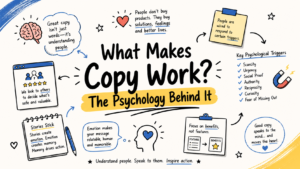
Before a person clicks, buys, or signs up, they tell themselves a story, a small internal sentence that makes the action feel logical, safe, or right.
Good copywriting writes that story for them, it plants the thought before the reader has consciously formed it. That’s not manipulation, it’s alignment. You’re meeting the reader where they already are and giving them a path forward that feels like their own idea.
Emotion opens the door logic closes the sale. What I mean by this is that people make decisions based on feeling, then justify those decisions with reasoning afterward. Copy that leads with specifications is trying to close the sale before it has opened the door. The logic matters, it just has to come second.
Specificity builds trust in a way that no amount of confident language can replicate. There is a reason the most effective direct response copy is full of numbers, names, and precise details. Not because readers consciously demand proof, but because specificity signals that someone was actually there, and the reader’s brain responds to that signal without being asked.
Friction is silent and costly. Every word that requires the reader to slow down, re-read, or figure something out is a small exit. Every undefined term, every overlong sentence, every moment of doubt that the copy fails to address, each one is a ramp off the path.
Great copywriting removes those ramps before the reader reaches them. It anticipates the hesitation and resolves it. The reader doesn’t experience this consciously, they just feel like the decision was easy.
You need to have this in your corner while you work…
Copywriting vs Content Writing: The Real Difference
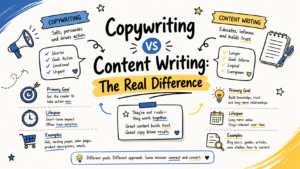
This is one of the most common points of confusion for people new to either discipline, and it is worth clearing up cleanly because confusing them leads to writing that does neither job well.
Content writing builds trust over time. A blog post about running shoes teaches you how to choose the right pair; heel drop, terrain, arch support.
An explainer about tax planning helps you understand your options before you need an accountant. The goal is education and attraction. The measure of success is traffic, time on page, and a reader who comes back.
Copywriting converts. An ad for running shoes makes you feel like you already need them right now, before you talk yourself out of it. A landing page for a tax service makes filing feel less overwhelming and the product feel like relief. The goal is a specific action in a specific moment. The measure of success is the click, the form, the purchase.
A blog post that reads like an ad feels pushy and untrustworthy. An ad that reads like a blog post is too slow, by the time it gets to the point, the reader is gone.
The best marketers know how to do both. But more importantly, they always know which one they’re doing at any given moment.
Knowing which mode you’re in is what separates competent from deliberate and deliberate is what makes the difference.
If you want to understand Ad copy, check this: Ad Copy Explained: What It Is, Why It Matters, and How Words Drive Action
Frequently Asked Questions About Copywriting
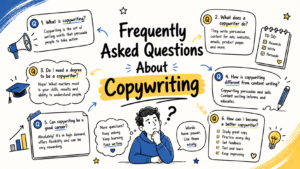
What is copywriting in simple terms?
Copywriting is writing that is designed to make someone take a specific action including click, buy, sign up, or believe something. It appears in ads, emails, landing pages, product descriptions, and anywhere a brand needs to persuade rather than just inform. It is not about sounding impressive. It is about being understood clearly enough to move someone.
What is the difference between copywriting and content writing?
Content writing educates and attracts over time. Examples include blog posts, guides, articles that build trust and bring people in. Copywriting converts. It activates a decision in the moment. Content asks: how do I earn their attention and keep it? Copywriting asks: how do I make them act right now? Both matter but they use different thinking.
What skills do you need to be a good copywriter?
Empathy is the foundation, you have to understand your reader’s world before you can write anything that lands. After that, clarity, because good copy says the most important thing in the fewest possible words. Specificity, because concrete details outperform vague claims every time. And curiosity, because finding the interesting angle inside an ordinary product is what separates copy that converts from copy that blends in.
Can anyone learn copywriting?
Yes. Copywriting is a skill, and skills are learnable. What helps most is not talent with words, it is genuine curiosity about people. The copywriters who get good at this are the ones who become interested in understanding what their reader wants, fears, and already believes.
What is the most important thing in copywriting?
Understanding the reader. Not the product, not the format, not the formula, the person on the other side. What do they want? What is in the way? What do they need to believe before they will act? If you can answer those questions specifically, the writing follows. Every other copywriting skill is built on top of that understanding.
This is the Final thing to think about…
Here is the thing about copywriting that I think matters most, and that most explanations of it miss; The best copy doesn’t feel like copy, it feels like the reader’s own thought, finally put into words.
That moment of recognition is not a trick, it’s the result of someone paying close enough attention to another person that the words came out right.
That’s the target. Not cleverness, not persuasion tactics, not a formula applied correctly. The reader, feeling understood. Everything else is in service of that.
Before you leave… visit adsforcopy.com for all the ads you can learn from and… Copy.