
Think about the last ad that actually made you feel something.
Not just notice it, feel it.
Maybe it was a line so simple you wondered why no one had said it before or maybe it named a frustration you’d been carrying around for months and couldn’t articulate, or maybe it just made you laugh and, without fully deciding to, you clicked.
Now think about the thousand other ads you scrolled past without registering. Same platforms. Same formats. Probably similar budgets. The difference between the ad that lands and the ad that disappears into the background is almost never the image, the targeting, or the spend. It’s the words. It’s the advertising copy.
This post is about understanding how advertising copy works.
Why certain words move people and others don’t. How the principles shift depending on whether you’re writing for a screen, a billboard, or a 15-second video. And what separates copy that earns attention from copy that wastes it.
What Is Advertising Copy?
Advertising copy is the written or spoken text in a paid advertisement. It is the specific words chosen to move a defined audience toward a defined action.
It appears across every media format such as search results, social feeds, display banners, TV spots, radio scripts, print spreads, outdoor boards, and podcast sponsorships. Its job is not to describe or decorate, it is to persuade. Every word is there because it earns its place, or it shouldn’t be there at all.
The distinction worth drawing early is that advertising copy is a specific discipline within the broader world of copywriting. General copywriting covers website pages, email newsletters, product descriptions, and brand voice guides.
Advertising copy is narrower and more urgent. It operates within tight constraints such as character limits, time limits, a viewer who didn’t ask to see it, and it has to make something happen quickly. There is no room for slow builds or gentle persuasion.
Consider Slack’s line: ‘Make work less work.’ Four words. It doesn’t explain what Slack does, how many integrations it has, or why it’s better than its competitors. It names the problem; work feels like too much work, and promises relief. That promise is what advertising copy does at its best. It finds the words the reader was already looking for.
Why Advertising Copy Works the Way It Does
Most explanations of advertising copy stay at the level of tactics: write a strong headline, include a clear CTA, keep it concise. Those things are true. But they don’t explain the underlying mechanics which is why a word choice that seems small can be the difference between a campaign that converts and one that doesn’t.
The first thing I’ve noticed, watching copy succeed and fail, is that words precede action. Before someone clicks, buys, or signs up, they tell themselves a small internal story. ‘This makes sense for me.’ ‘This is the kind of thing I’d do.’ ‘I need this.’ The story comes first.
The action follows. Good advertising copy doesn’t wait for that story to form on its own, it writes it. It hands the reader the sentence that makes the action feel logical before they’ve consciously decided anything.
Specificity is one of the most underestimated mechanics in persuasive advertising. Vague language signals vague thinking, and vague thinking signals risk.
‘Incredible results’ means nothing, a reader’s brain treats it as background noise. ‘Reduced cart abandonment by 34% in 90 days’ means something, the brain accepts it as evidence. The specific detail is the proof. It makes the claim feel real in a way that no amount of superlative language can.
There’s a friction dimension too, and it operates invisibly. Every word that creates confusion, hesitation, or doubt costs you the action. Every extra step, every unexplained term, every moment where the reader has to work to understand what’s being offered, each one is a small exit ramp. Great advertising copy removes those ramps before the reader reaches them. It makes the path forward feel clear and frictionless. The reader doesn’t have to decide to say yes. They just have to not say no.
Related post: Ad Copy Explained: What It Is, Why It Matters, and How Words Drive Action (2026 Guide)
How Advertising Copy Changes Across Media
Digital Advertising Copy
Digital copy such as search ads, social ads, display banners, sponsored content operates inside brutal constraints. A Google headline gives you 30 characters. A Facebook primary text gives you roughly three seconds before the reader scrolls. The copy doesn’t just have to be good. It has to be good immediately.
What this means in practice is that digital advertising copy is scroll-aware and platform-specific. The tone that works on LinkedIn (measured, professional, direct) would feel off on Instagram, where the audience expects something more visual, more personal, occasionally more playful. The principle of clarity holds everywhere. The execution shifts per platform.
Print & Outdoor Advertising Copy
Print and outdoor advertising copy lives in a permanent medium with no interactive layer. There’s no button to click, no link to follow in the moment, no retargeting pixel to catch the people who looked but didn’t act. The copy has to do more work with fewer tools, and it has to do it in a single, sustained impression.
What I find interesting about outdoor copy in particular is that it forces a kind of discipline that digital doesn’t. A billboard has to work at 60 miles per hour, in under three seconds, for an audience that isn’t looking for it. This strips away everything optional.
The visual and the copy become inseparable partners where the image earns the glance and the copy earns the thought.
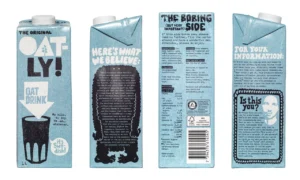
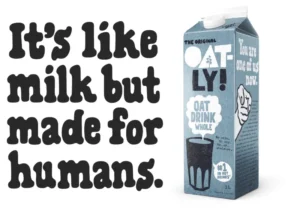
Oatly’s carton copy is a good example of this principle applied to print packaging: conversational, unpredictable, designed to be read slowly, the permanence of the medium turned into an asset.
Video & Audio Advertising Copy
Video and audio copy is spoken, not read, which changes everything. Rhythm matters. Sentence length matters in a way it doesn’t on a page. And the hook must work inside the first three seconds, because that’s when a pre-roll viewer can skip. The entire structure of a video script is built around that constraint: earn the next three seconds, then the next three, then the next.
What I’ve noticed in video ad copy that works, especially in short-form formats is that the hook rarely leads with the product. It leads with the problem, the tension, or the moment. ‘You know that feeling when you open your inbox and immediately close it?’
That’s a hook. It creates recognition before it creates relevance. The product comes later, once the viewer has already nodded along.
Dollar Shave Club’s launch video built an entire brand on this structure: the problem (overpriced razors) named immediately, the solution introduced conversationally, the CTA delivered before the viewer had time to look away.
The Anatomy of Persuasive Advertising Copy
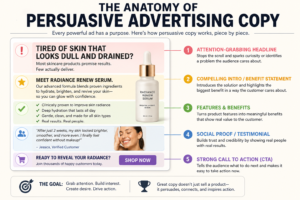
The Hook
The hook is the first moment of contact. It is the line that determines whether the reader keeps going or doesn’t. What a hook must do, psychologically, is create a gap. A small opening between what the reader knows and what they want to know next. Curiosity is a gap. Recognition is a gap.
Provocation is a gap. The weak hook fills the gap immediately; ‘Get 20% off our software this week.’ The strong hook opens one; ‘The reason your ads keep failing has nothing to do with your budget.’
The difference isn’t cleverness. It’s understanding that attention is not given, it’s earned, one sentence at a time.
The Value Proposition
The value proposition is the answer to the reader’s most honest question; what’s in this for me? Not what the product does but what it does for me, in my actual life, with my actual problems. The gap between features and value is where most advertising copy quietly fails.
A weak value proposition says ‘Cloud-based storage with 256-bit encryption and cross-device sync.’
A strong one says ‘Your files, everywhere you are, and only yours.’ Same product. The first describes a mechanism. The second describes a life. The reader doesn’t want the encryption. They want the peace of mind it produces. Good ad copywriting speaks to the outcome, not the specification.
The Proof
Proof is the section of advertising copy that makes the claim believable. And it matters more than people give it credit for, because the reader arrives with skepticism already loaded.
They’ve been oversold before. They’ve seen ‘revolutionary’ and ‘game-changing’ applied to things that were neither. The proof disarms that skepticism, not with superlatives, but with specifics.
A number. A name. A result with a timeframe. A quote from a real person. Any of these is more persuasive than another adjective. ‘Over 40,000 teams use it’ is proof. ‘Customers report saving 6 hours a week’ is proof. ‘This is fine software’ is not proof, it’s noise.
The Call to Action
The CTA is the instruction. And the language of that instruction carries more weight than it seems. ‘Buy Now’ and ‘Start Your Free Trial’ are doing very different psychological work. One creates pressure. The other removes it. ‘Get Instant Access’ creates urgency without demanding commitment. ‘See How It Works’ lowers the stakes for someone who isn’t ready to decide.
The best calls to action are specific, low-friction, and honest about what happens next. They don’t trick. They guide. The reader who clicks ‘Start Your Free Trial’ knows exactly what they’re agreeing to and that clarity is what makes them comfortable enough to click.
Advertising Copy Examples: And What Makes Them Work
The best way to understand advertising copy is to look at it working. Here are four examples from brands that have consistently produced copy worth studying.
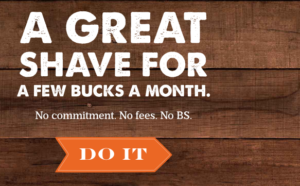
- Dollar Shave Club: ‘A great shave for a few bucks a month. No commitment.’ What this copy does is remove every objection in a single sentence. Price concern: handled (‘a few bucks’). Quality concern: handled (‘great shave’). Commitment concern: handled (‘no commitment’). The technique at work is anticipating the reader’s hesitation and resolving it before it forms.
- Oatly: ‘It’s like milk, but made for humans.’ This line is playful and slightly provocative, it implies something unflattering about cow’s milk without saying it outright. What it actually does psychologically is reframe the alternative. It doesn’t position Oatly as a niche product for specific dietary needs. It positions dairy milk as the unusual choice. The technique here is reframing the competitor rather than attacking them, by making the category feel newly strange.
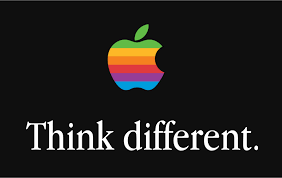
- Apple: ‘Think Different.’ Two words that say nothing about a product and everything about an identity. Apple isn’t selling a computer here, it’s offering membership in a tribe. The reader’s implicit question is: ‘Am I the kind of person who thinks differently?’ The copy bets that enough people want the answer to be yes. The technique is identity-based positioning that makes the audience want to qualify, rather than telling them they already do.
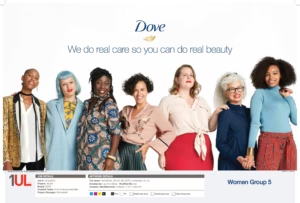
- Dove: ‘Real beauty.’ Two words that launched a campaign, repositioned a category, and ran for years. In an industry that had spent decades telling women what beauty was supposed to look like, Dove said something different and the contrast was the message. The technique is strategic simplicity that gains its power from what the reader already knows about everything else in the category.
For a deeper look at advertising copy examples across industries and formats with breakdowns of what’s working in each one, the Ad Copy Examples post is where we get into more than twenty of them.
Common Mistakes in Advertising Copy
Writing to everyone.
This is the mistake I see most often. The brief says ‘broad audience’ and the copy ends up speaking to no one specifically. The result is advertising that feels generic, technically correct, professionally produced, and completely forgettable. Copy that tries to be relevant to everyone ends up resonating with no one. The fix isn’t writing narrower, it’s writing more specifically to the person who actually matters most.
Describing instead of communicating value.
There’s a version of advertising copy that reads like a product specification sheet including feature lists, technical details, capability summaries. This isn’t wrong exactly. It’s just incomplete. Readers don’t buy features, they buy outcomes. They buy the version of their life in which the feature is already doing its job. Copy that describes a product without translating it into the reader’s world is leaving most of its persuasive work undone.
Weak openings.
The first line of an ad is doing the most important work in the entire piece and it’s the part that’s most often written last, or treated as a formality. ‘Introducing our new platform.’ ‘Are you tired of…’ ‘We’re excited to share…’ These openings signal nothing distinctive. They create no gap, no tension, no reason to keep reading. The opening line is the whole ad in miniature. If it doesn’t earn the next sentence, nothing else matters.
CTAs that don’t match where the reader is.
A call to action asks the reader to do something and the size of that ask has to match the amount of trust the ad has built. A cold audience seeing an ad for the first time isn’t ready for ‘Buy Now.’ They might be ready for ‘See how it works.’ Mismatched CTAs don’t just fail to convert they create friction that makes the whole ad feel pushy. The reader senses the mismatch even if they can’t name it.
Frequently Asked Questions About Advertising Copy
What is advertising copy in simple terms?
Advertising copy is the text in an ad. It is the specific words written to make the reader take a defined action, like clicking a link, buying a product, or signing up for a service. It appears across all paid media: digital, print, TV, radio, outdoor. Its purpose is always persuasion.
What’s the difference between advertising copy and content writing?
Content writing builds trust and attracts an audience over time. Examples include; blog posts, guides, educational articles. Advertising copy converts. It operates under time and space constraints, with a direct action as the goal. Content asks: how do I earn their attention? Ad copywriting asks: how do I make them act right now? Both matter, but they use different muscles.
How do you write persuasive advertising copy?
Start with the reader, not the product. Understand what they want, what they’re afraid of, and what language they use to describe their own problem. Then write the copy that puts them at the centre of their outcome, their friction and their story. Persuasive advertising copy doesn’t try to impress. It tries to connect. The clearer and more specific the connection, the stronger the copy.
What are the types of advertising copy?
The main categories include short-form (social ads, search ads, display banners), long-form (landing pages, sales letters, email sequences), video and audio scripts, and print or outdoor copy. Each format has different constraints and different persuasion mechanics, but they all share the same core job: clarity, relevance, and a reason to act.
Does advertising copy differ by platform?
Yes! In tone, length, and structure. Google search copy is intent-driven and character-limited. Instagram copy is scroll-aware and visual-first. LinkedIn copy is more measured and professionally framed. Video copy is built around a three-second hook. The principles of good advertising copy don’t change across platforms, the execution does. Understanding the platform means understanding the reader’s state of mind when they encounter the ad.
Here is my final thinking on this matter…
The best advertising copy doesn’t feel like advertising, it feels like recognition, like someone finally said the thing you’d been thinking.
That’s the standard worth holding. Does the reader feel understood? Do the words hand them the story they were already trying to tell themselves?
That question is harder to answer than any checklist. It requires actually knowing the person on the other side of the ad, not just their demographic profile, but their internal monologue.
What they want, what they’re tired of, what they’d say if you asked them to describe the problem in their own words.
Any ways… check out Adsforcopy, where you have thousands on Ad copies at your flix.